Lead qualification questions for interior design firms
On this page
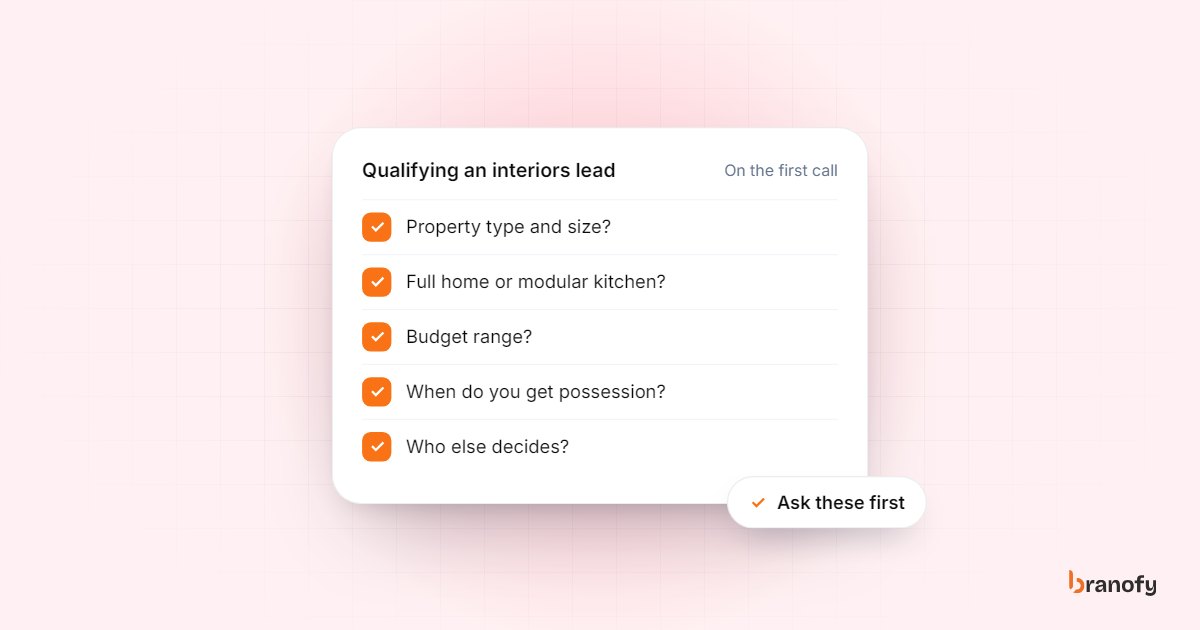
The lead qualification questions an interior design firm should ask on the first call are about the property, the scope, the budget, the site location, who decides and when work can start. In India that means asking the BHK configuration, the possession or handover date, whether they want modular kitchen and wardrobes or a full home, a budget range in rupees, the site address, and who else is part of the decision. Seven or eight short questions are enough to tell a serious homeowner from someone collecting quotes for fun.
Below are the questions, the order to ask them in, and how to run them on every lead without tying up your designers.
Why interiors leads need qualifying fast
Interior design leads from Meta ads, Google search and property portals look similar on a spreadsheet: a name, a number, maybe a city. Behind them is a wide spread of intent:
- A family that gets keys to a 3 BHK in Whitefield next month and wants a full home done.
- A buyer whose flat in Hinjewadi is possessing in 18 months, just browsing.
- Someone who wants only a wardrobe replaced.
- A tenant who cannot drill into walls.
- Another interior firm checking your prices.
Each of these deserves a different response. Your designer's time, site measurement visits and 3D renders are expensive, so the goal of qualification is simple: spend them on the people who are ready and fit what you do, and keep the rest warm until they are.
Homeowners also enquire with several firms at once. The firm that calls first, asks sensible questions and books a site visit usually sets the reference point everyone else is compared against.
The core questions, in the order to ask them
Ask these in a natural order. Start with the property, because it is easy to answer and tells you a lot, then move to scope and money once the conversation is going.
1. "Which property is this for, and what configuration is it?"
You want the BHK (1, 2, 3, 4 BHK or villa), apartment vs independent house, and roughly the carpet area if they know it. This sets the scale of the project before budget comes up, and it tells you whether the lead matches the kind of work you do.
2. "Is it a new flat, or one you're already living in?"
New handovers and lived-in renovations are very different jobs. A new flat is usually a cleaner modular-plus-furnishing project. A lived-in home means removing old fittings, families moving out for a while, and society permissions.
3. "When is possession, or when do you get the keys?"
This is the single most useful timing question in Indian interiors. A possession date three months away is a hot lead. One two years away is a nurture lead. If they already have the keys, ask whether they are living there or waiting to move in.
4. "What would you like us to do: modular kitchen and wardrobes, or the full home?"
Scope decides the size of the job and which team handles it. Offer simple choices:
- Modular kitchen only
- Kitchen plus wardrobes
- Full home interiors (modular, false ceiling, lighting, painting, furnishing)
- A specific room or a renovation
Most leads can pick from a short list.
5. "Do you have a budget range in mind?"
The most important question, and the one people avoid. Ask it plainly and give ranges so the buyer does not have to name a number. Build the brackets around your own price list. A firm doing mostly 2 and 3 BHK full homes might use brackets like these:
| Example bracket | What it usually tells you |
|---|---|
| Under ₹3 lakh | Likely kitchen or wardrobes only; check if you take such projects |
| ₹3 lakh to ₹8 lakh | Modular kitchen plus wardrobes, or a smaller full home |
| ₹8 lakh to ₹15 lakh | Full home for a typical 2 or 3 BHK, depending on finishes |
| Above ₹15 lakh | Larger homes, premium finishes or villas |
These brackets are only an example. Set yours based on what your projects actually cost, so that each bracket points to a clear next step on your side.
If the buyer says "we don't know yet", ask: "Would it be closer to a modular kitchen and wardrobes, or a complete home?" That usually gets you to a bracket.
6. "Where is the property?"
Ask for the locality and project name, not just the city. A firm based in JP Nagar may happily take Bannerghatta Road but not Devanahalli. Location tells you whether site supervision is practical and which designer should own the lead.
7. "Who else will be involved in the decision?"
In Indian homes, interiors are rarely one person's decision. A spouse, parents or the person paying may need to approve the design. Ask gently: "Will anyone else be joining the design discussion, so we can plan the meeting when everyone is available?"
This also helps you book the site visit or showroom meeting when the actual decision-makers can attend.
8. "When would you like the work to start, and is there a move-in date?"
A griha pravesh date, a lease ending, a child's school starting or a family function gives you a real deadline. Leads with a fixed move-in date are usually the ones ready to sign.
Optional questions that save time later
Add one or two of these if they matter to how you work:
- "Have you spoken to other designers yet?" Tells you how far along they are, without sounding defensive.
- "Do you have a style in mind, or photos you like?" Useful for the designer, and a good sign of engagement if they say yes.
- "Is this home to live in, or to rent out?" Rental flats usually need durable, simpler finishes and tighter budgets.
- "Do you need help with a home loan or payment in stages?" Only if you offer staged payments or work with financing partners.
- "Are you enquiring for yourself or for a client?" Politely separates homeowners from other firms and builders' sales teams.
How to ask the awkward questions without losing the lead
Budget and decision-maker questions feel uncomfortable because people worry they sound pushy. Three habits help:
- Explain why you are asking. "So we suggest designs that fit, could you share a rough budget?" sounds helpful, not nosy.
- Give options instead of open questions. Choosing from ranges is easier than inventing a number.
- Accept "not sure" and move on. A vague answer is still information. Note it and keep the call friendly.
Keep the whole call short, around three to five minutes. You are not selling the project on this call. You are deciding whether to book a site visit or showroom meeting, and booking it if the answers fit.
Turning answers into hot, warm and cold
Agree as a team what each label means, so everyone treats leads the same way. A simple version for an interior firm:
- HOT: Possession within three months or already has keys, scope and budget fit your work, decision-maker reachable. Book a site measurement or showroom visit on this call.
- WARM: Good fit but possession is three to twelve months away, or budget is undecided. Send your portfolio on WhatsApp and follow up on a schedule.
- COLD: Possession over a year away, scope or location you do not serve, or no real project. Keep in a long-term nurture list, or close politely.
The point of labels is action. Hot leads get a designer's callback the same day; warm leads go into a follow-up sequence; cold leads stop consuming your designers' time.
Asking these questions on every lead with AI calling
The hard part is not knowing the questions. It is asking them on every lead, quickly, including the ones that arrive at 10 pm on a Sunday after someone saw your Reel.
That is where an AI calling agent helps. Branofy's Pre-Sale Agent calls each new lead within 10 seconds of it arriving, from Meta, Google, 99acres, MagicBricks, website forms or a Google Sheet. It confirms identity, asks industry-specific questions, then asks your own screening questions, set up however you want, such as possession date, scope and budget bracket. It can switch to Kannada, Tamil or Hindi mid-call if the homeowner does.
Each lead comes out as HOT, WARM or COLD with a recording, transcript and summary, and interested homeowners can be booked straight onto your team's calendar for a site visit. Warm leads can then move into WhatsApp and email follow-ups automatically.
The same approach works for builders and brokers; see how we set it up for real estate and property businesses. If you are weighing the cost, the pricing page lists plans and minutes in rupees.
A first-call script you can copy
"Hi, this is [name] from [firm]. You enquired about interiors for your home a few minutes ago, is now a good time for two minutes?
Which property is it for, and is it a 2 or 3 BHK? … When do you get possession? … Are you looking at modular kitchen and wardrobes, or the full home? … To suggest the right options, would your budget be closer to [bracket A] or [bracket B]? … Which locality is the flat in? … Will anyone else be joining the design discussion?
Great. Our designer can visit to measure on Saturday at 11 am or Sunday at 4 pm. Which works better? I'll send our portfolio and the details on WhatsApp now."
Adjust the brackets and slots to your business, and keep the tone conversational rather than a form being read out.
Frequently asked questions
How many qualification questions should I ask on the first call?
+
Six to eight is plenty: property and BHK, possession date, scope, budget range, location, decision-maker and start date. More than that turns the call into an interrogation. Save style and material preferences for the site visit.
Should I ask about budget on the first call?
+
Yes. Without a budget range you cannot tell whether a site visit is worth it. Give rupee ranges so the homeowner can pick one, and explain that it helps you suggest designs that fit.
What if the possession date is more than a year away?
+
Treat it as a warm or cold lead, not a lost one. Send your portfolio, add them to a slow follow-up sequence, and call again a few months before handover when they start making decisions.
Can an AI agent ask interiors-specific questions?
+
Yes. The screening questions are set up for your business, so you can include BHK, possession date, scope, budget bracket and locality. The answers are recorded and summarised, and the lead is marked HOT, WARM or COLD for your team.
How do I filter out other interior firms checking my prices?
+
Ask politely whether they are enquiring for their own home or on behalf of a client, and ask for the project name and locality. Genuine homeowners answer easily. Our note on filtering brokers from buyers uses the same approach.
How Branofy does this for you
Branofy qualifies and scores leads for you
- Every lead is called within 10 seconds and asked the screening questions we set up for your business.
- Each lead is scored HOT, WARM or COLD with an AI summary, so your team calls the right people first.
- Assignment rules route each lead to the right person in your team automatically.
Want this working for your leads?
Leave your details and we'll call you back to show Branofy on your own lead flow.
Related Articles
Lead scoring model template for Indian SMBs (with points table)
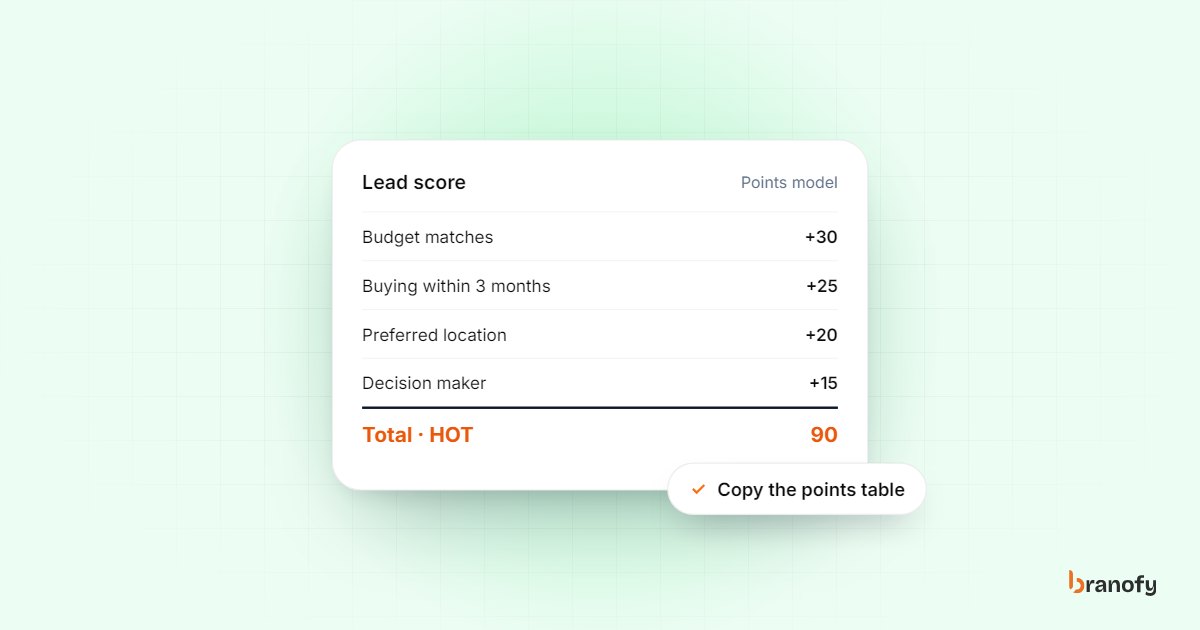
A simple, ready-to-use lead scoring template for Indian businesses buying Meta and portal leads, with a points table, thresholds and how to act on each score.
January 10, 2026
Benefits of AI voice agents for SMB sales teams in India
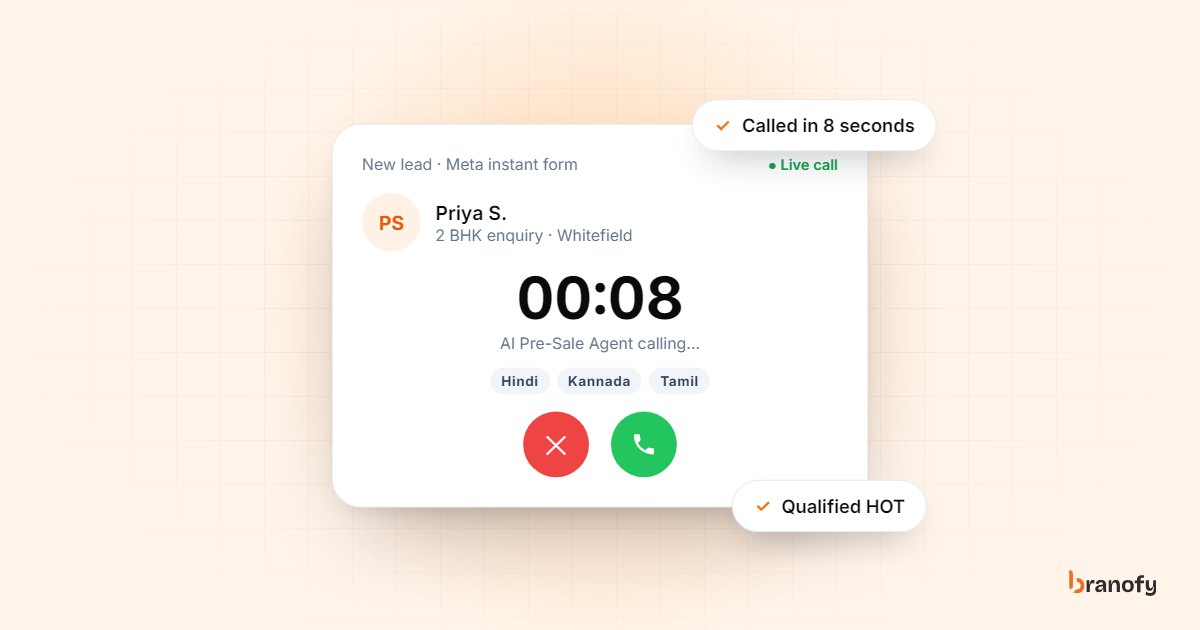
AI voice agents call every new lead in seconds, qualify in the buyer's language and book visits at any hour. Here is where they help and where humans still win.
December 23, 2025
How AI lead scoring is transforming service businesses
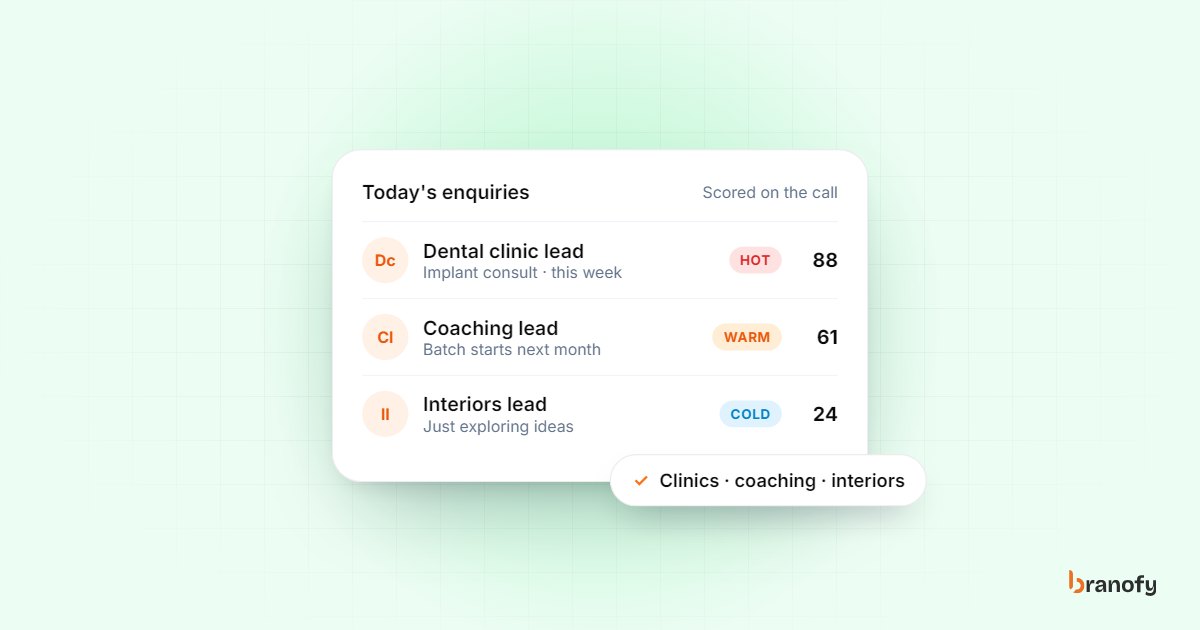
How AI qualification on the first call sorts clinic, coaching and interiors leads into HOT, WARM and COLD with reasons, and how your team should act on each.
December 6, 2025