Lead scoring model template for Indian SMBs (with points table)
On this page
A lead scoring model gives each enquiry points for the signals that predict a sale, such as budget fit, buying timeline and whether the person actually answered your call, so your team calls the best leads first. Below is a simple points template built for Indian businesses that buy leads from Meta, Google and portals, not for B2B software companies. Copy the table, adjust the points to your business, and review it against real outcomes every month.
Why most lead scoring templates do not fit Indian SMBs
Search for a lead scoring template and you will mostly find B2B models: job title, company size, industry, email opens, pricing page visits. That works for a software company selling to managers. It does not work for a developer in Whitefield, a dental clinic in Pune or a coaching institute in Hyderabad.
Your leads are individuals and families. They fill a Meta instant form or a portal enquiry, often on their phone, often late at night, and often with several of your competitors in the same sitting. What predicts a sale for you is simpler:
- Does what they want match what you sell (budget, location, product)?
- Do they need it soon?
- Are they the person who decides?
- Did they actually respond when you reached out?
- Are they genuine (not a broker, not a wrong number, not a duplicate)?
A good B2C template scores those five things and nothing else.
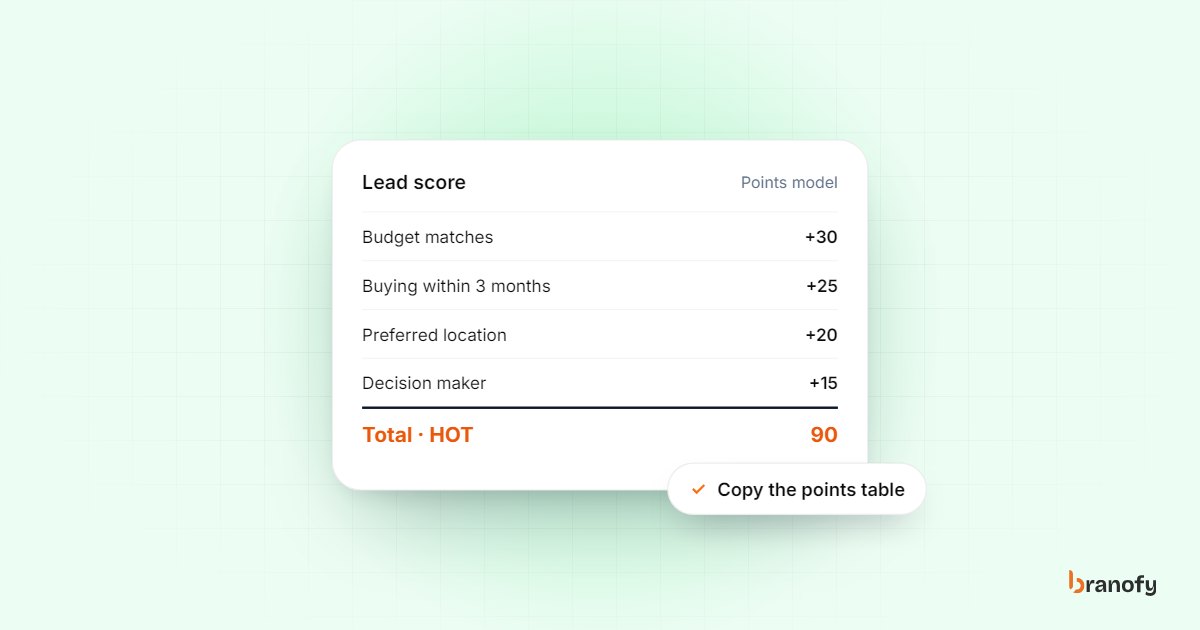
The lead scoring template
Use this as your starting point. Each lead starts at zero; add or subtract points for each signal that applies.
| Category | Signal | Points |
|---|---|---|
| Fit | Budget is within your price range | +20 |
| Preferred location or branch is one you serve | +10 | |
| Wants a product or service you actually offer (configuration, course, treatment, model) | +10 | |
| Intent | Plans to buy or start within 3 months | +20 |
| Plans to buy within 3 to 12 months | +10 | |
| Is the decision-maker, or the decision-maker is involved | +10 | |
| Engagement | Answered the first call and completed the qualifying questions | +15 |
| Replied on WhatsApp or asked a specific question (price, availability, timings) | +10 | |
| Agreed to a site visit, appointment, test drive or counselling session | +25 | |
| Source | Enquired on a specific listing or a high-intent search ad | +5 |
| Repeat enquiry from the same person within 30 days | +5 | |
| Negative | Budget far below your lowest price | -20 |
| Only "exploring", no timeline | -10 | |
| Broker or agent posing as a buyer | -30 | |
| No answer after 3 calls and no WhatsApp reply | -15 | |
| Wrong number, fake details or says they did not enquire | Disqualify |
The points are deliberately round. They are a judgement about what matters, not a precise formula, and you will adjust them once you see results.
Setting thresholds and what to do at each level
A score is only useful if it changes what your team does. Set three bands and a clear action for each.
| Score | Band | Action |
|---|---|---|
| 70 and above | Hot | Senior salesperson calls the same day; book or confirm the visit or appointment |
| 40 to 69 | Warm | Call within 24 hours; WhatsApp nurture sequence with brochure, offers and reminders |
| Below 40 | Cold | Automated WhatsApp and email nurture; re-score if they reply |
Start with these cut-offs, then look at your pipeline after a month. If most of your bookings came from "warm" leads, your hot threshold is too high, or one of your signals is worth more than you thought.
Adapting the template for your industry
The categories stay the same across industries; the signals inside them change.
Real estate developers and brokers
- Fit: budget band, configuration (2 BHK, 3 BHK, villa plot), micro-market.
- Intent: self-use or investment, possession preference (ready-to-move or under construction), home loan pre-approval.
- Negative: broker enquiries, which you can catch with a neutral question like "Are you enquiring for yourself or for a client?"
Our real estate solutions page shows how this fits into a full site-visit pipeline.
Clinics and hospitals
- Fit: treatment you offer, nearest branch, insurance accepted.
- Intent: wants an appointment this week vs general information.
- Engagement: confirmed an appointment slot.
Coaching institutes and EdTech
- Fit: student's class and target exam match your courses, fee range acceptable.
- Intent: batch start date, parent involved in the decision.
- Engagement: booked a counselling session or attended an orientation.
See how coaching businesses run this on our EdTech page.
Car dealers
- Fit: model and variant you stock, budget, finance or exchange.
- Intent: purchase timeline, test drive requested.
Interiors and construction
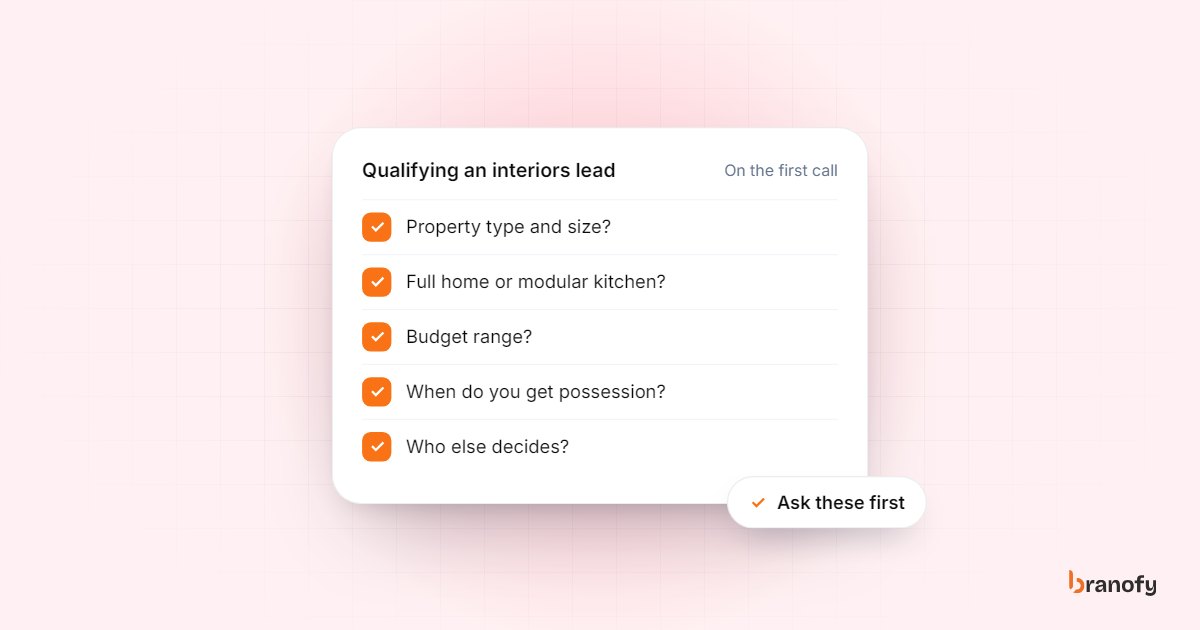
- Fit: BHK and scope (modular kitchen vs full home), site location within your service area, budget range.
- Intent: possession date or construction stage, decision-maker on the call.
Where the score data comes from
Points are only as good as the information behind them. The fit and intent signals mostly come from two places:
- Lead form questions. A Meta instant form or portal enquiry can ask budget, location and timeline. Keep it short, because every extra field lowers the number of form fills.
- The first conversation. Most of the valuable signals, such as timeline, decision-maker and whether the person is a broker, only come out when someone talks to the lead.
That second point is why speed matters. A lead you do not reach cannot be scored beyond the form fields. If your team calls the next afternoon, half your scores are guesses.
How conversation-based qualification complements the points model
A points model is a summary of signals. A conversation is where you actually collect them, and it adds something a points table cannot: the reason behind the answer.
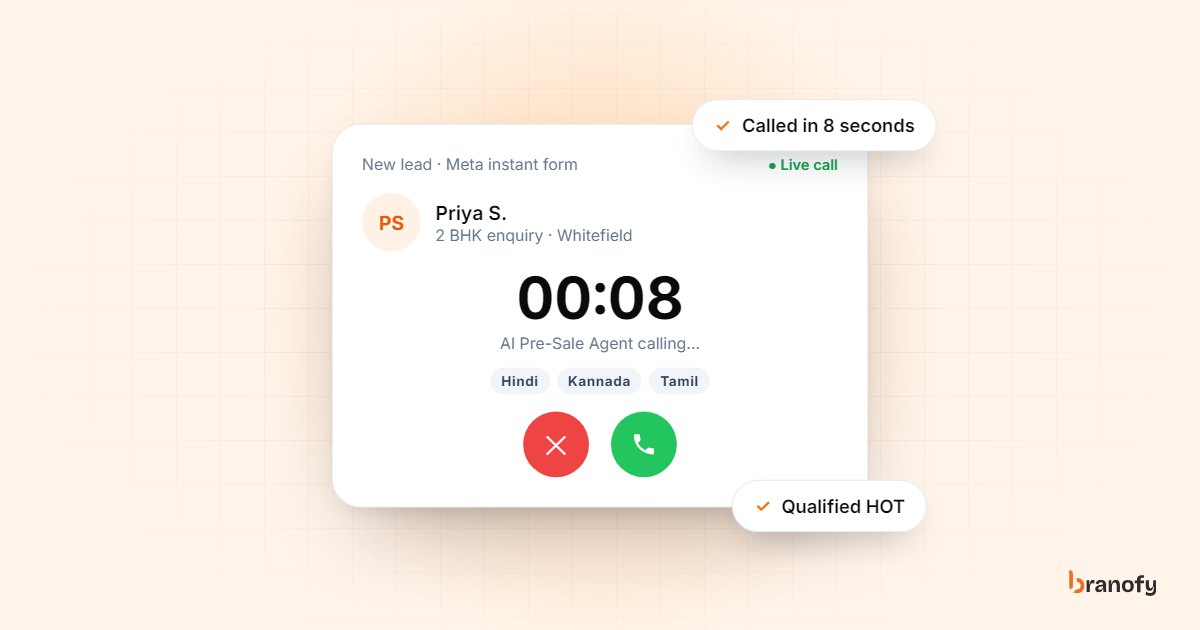
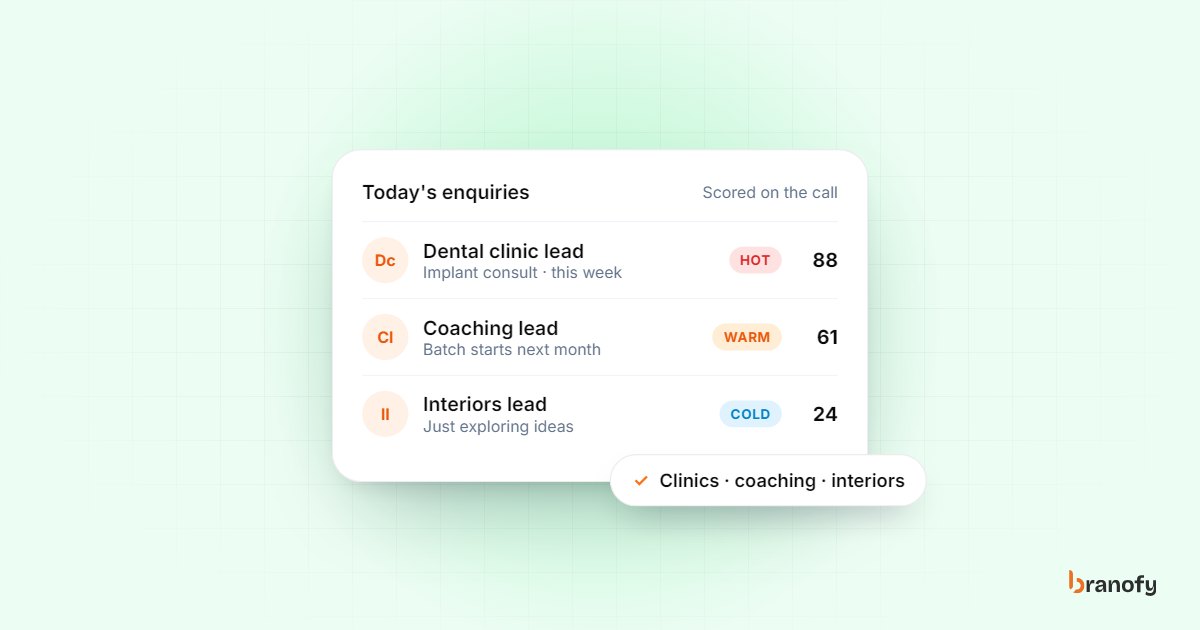
Branofy's Pre-Sale Agent calls every new lead within 10 seconds, day or night, and runs a three-layer qualification: first identity and reachability (is this a real person who enquired), then industry-specific intent questions, then your own custom questions. Each lead comes out as HOT, WARM or COLD, along with a recording, a transcript and an AI summary of what the person said, for example "3 BHK, self-use, ₹1.2 to 1.4 crore, wants to visit Sunday, spouse will join".
The two work together:
- The call fills in your scoring fields. Timeline, budget, decision-maker and broker status come straight from the conversation instead of a telecaller's memory.
- HOT/WARM/COLD gives an instant first sort. Your team knows who to call back first without adding points by hand.
- The summary explains the score. A salesperson sees why a lead is warm, not just that it is, and can open the next call with the right context.
- The pipeline score handles what happens next. Replies, visits booked and no-shows keep updating the lead's position in the CRM.
Branofy's AI CRM also includes lead scoring and AI lead summaries alongside pipelines and assignment rules, so hot leads can be routed to your best closers automatically. To be clear about what it is: this scoring reflects the answers and activity on each lead; it is not a machine-learning model trained on your historical sales data. Plans are listed on the pricing page.
How to check your model is working
Once a month, pull the leads from the previous month and compare their score bands with what actually happened.
- What share of hot leads booked a visit or appointment, compared with warm and cold?
- Did any cold leads convert? What did they have in common?
- Are there signals your team keeps mentioning in notes that are not in the model?
- Is any signal so common that it no longer separates good leads from poor ones?
Adjust one or two weights at a time, and keep a note of what you changed so you can tell what helped.
Common mistakes to avoid
- Too many signals. Ten to fifteen is plenty. Past that, nobody can explain why a lead scored what it did.
- Scoring only the form. Form answers are cheap to give. Give more weight to what the person said and did after the enquiry.
- No negative points. Brokers, wrong numbers and far-off budgets should pull a score down, or they will clog your hot list.
- Never revisiting it. Your offer, prices and campaigns change. Your scoring should too.
- Scores nobody acts on. If hot and cold leads get the same follow-up, the model is decoration.
Frequently asked questions
What is a good lead scoring model for a small business?
+
A simple points model with four to five categories (fit, intent, engagement, source and negatives) and ten to fifteen signals is enough for most small businesses. What matters is that each score band triggers a clear action, such as a same-day senior call for hot leads.
How many points should a hot lead have?
+
There is no universal number; it depends on how you weight your signals. With the template above, start with 70 and above as hot and 40 to 69 as warm, then adjust after a month based on which bands actually booked visits or appointments.
Should I score leads before or after the first call?
+
Both. Give a starting score from the form fields as soon as the lead arrives, then update it after the first conversation, because timeline, decision-maker and broker status usually only come out on the call.
Is AI lead qualification the same as lead scoring?
+
Not exactly. Lead scoring adds up points for signals; AI qualification on a call collects those signals by talking to the lead and sorts them into HOT, WARM or COLD with a summary of the reasons. Used together, the call gives you accurate inputs and the score keeps tracking what happens afterwards.
How often should I update my lead scoring model?
+
Review it monthly in the first few months, comparing score bands with actual visits, appointments and sales. After that, review it whenever your pricing, offer or main lead sources change.
How Branofy does this for you
Branofy qualifies and scores leads for you
- Every lead is called within 10 seconds and asked the screening questions we set up for your business.
- Each lead is scored HOT, WARM or COLD with an AI summary, so your team calls the right people first.
- Assignment rules route each lead to the right person in your team automatically.
Want this working for your leads?
Leave your details and we'll call you back to show Branofy on your own lead flow.
Related Articles
Benefits of AI voice agents for SMB sales teams in India
AI voice agents call every new lead in seconds, qualify in the buyer's language and book visits at any hour. Here is where they help and where humans still win.
December 23, 2025
Lead qualification questions for interior design firms
The first-call questions interior firms in India should ask every lead: BHK, possession date, scope, budget in rupees, location, decision-maker and timeline.
December 20, 2025
How AI lead scoring is transforming service businesses
How AI qualification on the first call sorts clinic, coaching and interiors leads into HOT, WARM and COLD with reasons, and how your team should act on each.
December 6, 2025