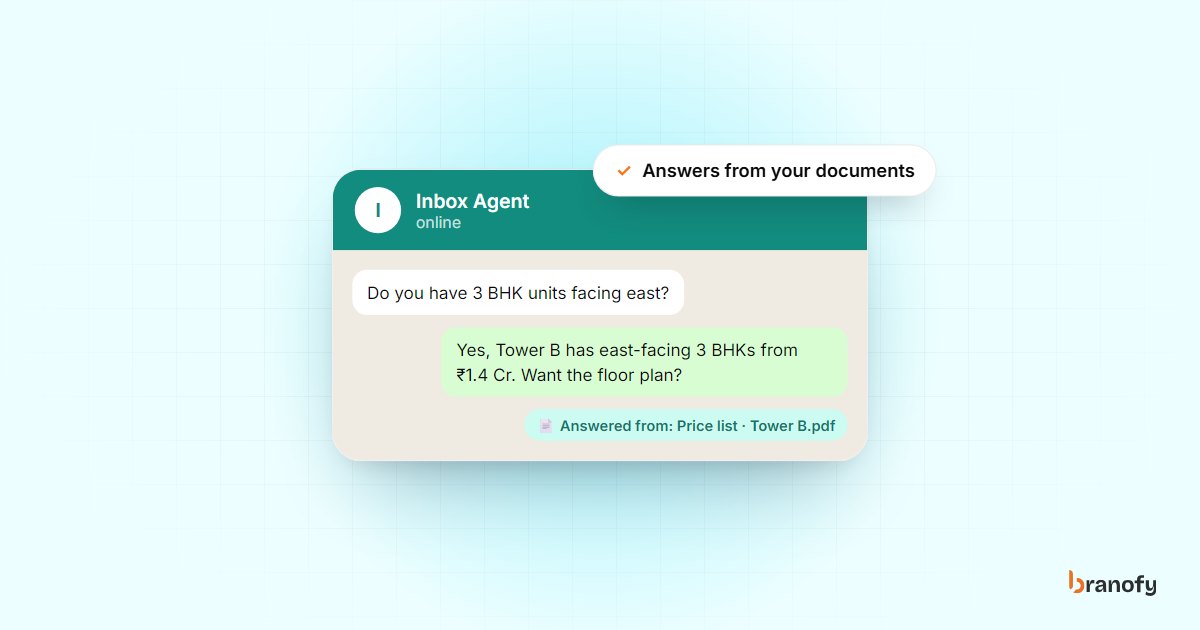
What is a RAG AI chatbot and how can it help your business?
On this page
A RAG AI chatbot is a chatbot that looks up the answer in your own business documents before it replies, instead of relying only on what a general AI model happens to know. RAG stands for retrieval-augmented generation: the bot retrieves the relevant facts (your price sheet, clinic timings, course fees) and then generates a natural reply from them. For a business, that means customers get answers that match what your team would say, at any hour, on WhatsApp, Instagram or your website.
This guide explains how RAG works without the jargon, where it helps Indian small and mid-sized businesses most, how to prepare your documents, and where a human still needs to step in.
RAG in plain words
A general AI model is like a well-read new hire on their first day. They can write fluent sentences on almost any topic, but they do not know your project's price per square foot, which doctor is available on Saturday, or whether your coaching batch has a weekend option. Ask them anyway and they may confidently guess.
RAG fixes this by giving the new hire a binder. Before answering, they open the binder, find the right page and answer from it. If the binder does not cover the question, a well-set-up bot says so and passes the conversation to a person.
The idea comes from a 2020 research paper, Retrieval-Augmented Generation for Knowledge-Intensive NLP Tasks by Patrick Lewis and colleagues, which combined a language model with a searchable document index so its answers were more factual and specific. The same principle now sits behind most business chatbots that answer from company information.
How a RAG chatbot answers from your documents
Under the hood there are four steps. You do not need to build any of them yourself, but knowing them helps you set the bot up properly.
1. Your content is collected
You give the system the material your team already uses to answer customers: FAQs, brochures, price lists, policies, timings, location details and past answers to common questions. This collection is usually called the knowledge base.
2. The content is split and indexed
The system breaks your documents into small passages and indexes them by meaning, not just keywords. So a customer asking "Is there parking?" can match a passage that says "Two covered car parks per 3 BHK unit", even though the words differ.
3. The relevant passages are retrieved
When a customer sends a message, the bot searches the knowledge base for the few passages most likely to contain the answer.
4. The reply is generated from those passages
The AI writes a short, conversational reply using only the retrieved facts, in the customer's tone and language. If nothing relevant was found, it should not invent an answer.
RAG chatbot vs a scripted bot vs a plain AI bot
Most business owners have used one of the older styles of chatbot. Here is how they compare.
| Scripted (menu) bot | Plain AI bot | RAG chatbot | |
|---|---|---|---|
| How it answers | Fixed buttons and pre-written replies | From the AI model's general training | From your own documents, written naturally |
| Handles free-text questions | Poorly; the customer must pick an option | Yes | Yes |
| Knows your prices and policies | Only what you scripted | No, and may guess | Yes, if they are in the knowledge base |
| Updating it | Rebuild the flow | Not possible for your facts | Edit or add a document |
The practical difference is that a RAG bot can hold a real conversation and still stay inside the facts you have approved.
Where RAG chatbots help Indian SMBs
The best use cases are businesses that get the same twenty questions every day, often late in the evening, and lose leads when nobody replies.
Real estate developers and brokers
Buyers who click a Meta ad or a portal listing ask about configuration, carpet area, price band, possession date, RERA number, loan tie-ups and site visit timings. A RAG bot answers these from your project brochure and price sheet, then offers a site visit slot. For a Pune or Bengaluru project running several towers, the knowledge base can hold each tower's details separately. See how this fits a full sales flow on our real estate solutions page.
Clinics and hospitals
Patients ask about doctor availability, OPD timings, consultation fees, which insurance is accepted, and how to reach the clinic. These answers change often, so a bot that reads from an updated timings document is far safer than one with hard-coded replies. Anything medical beyond general information should go straight to staff. Our healthcare page covers how clinics handle enquiries end to end.
Coaching institutes and EdTech
Parents and students ask about course fees, batch timings, online vs offline options, scholarship tests, refund policy and orientation session dates. A RAG bot can answer in the language the parent writes in and capture the student's class and target exam for the counsellor.
Travel agencies, hotels and resorts
Guests ask what a package includes, check-in times, pet policy, meal plans and cancellation terms. The bot answers from your policy documents and hands over to your team for anything that needs a custom quote.
Car dealers and interiors firms
Showroom timings, variants on display, test drive booking, modular kitchen options and what a site measurement visit involves are all good candidates.
How to prepare a knowledge base that gives good answers
A RAG bot is only as good as the documents behind it. Most bad answers come from missing, outdated or contradictory content, not from the AI.
- Start from real questions. Export a month of WhatsApp chats or ask your sales and front-desk team to list the questions they answer daily. Write one clear answer for each.
- Write facts plainly. "Consultation fee for Dr. Rao is ₹800, Monday to Saturday, 10 am to 2 pm" retrieves better than a paragraph of marketing copy.
- Keep one version of the truth. If two documents give different possession dates, the bot may quote either. Remove old brochures and price lists.
- Say what you do not share. If you never quote final prices on chat, write that down, along with what the bot should do instead (offer a call or visit).
- Date anything that changes. Offers, batch start dates and price revisions should carry an effective date so they can be updated on time.
- Review weekly at first. Read a sample of conversations, find questions the bot could not answer, and add those answers.
Where a human still has to step in
A good chatbot knows its limits. Plan for these handovers from day one:
- Negotiation and custom quotes. Price discussions, discounts and package customisation belong with your sales team.
- Upset or anxious customers. A delayed possession, a billing dispute or a worried patient needs a person, quickly.
- Anything sensitive. Medical advice, legal questions and complaints should not be answered by a bot.
- Questions the knowledge base does not cover. The bot should say it will connect them to the team rather than guess.
The handover should carry the full conversation so the customer does not have to repeat themselves.
How Branofy's Inbox Agent uses RAG
Branofy's Inbox Agent replies on WhatsApp, Instagram DM, Facebook Messenger and your website chatbot from your business's own knowledge base. The same knowledge base is shared by all the AI agents on the platform, so the AI that answers chats and the Pre-Sale Agent that calls new leads give the same facts.
It watches for emotion in the conversation and escalates to a human when a customer is frustrated, and your team can take over any chat from the WhatsApp team live chat. Follow-up Automation is included with the Inbox Agent, so leads who stop replying get a WhatsApp or email nudge based on their status or inactivity. WhatsApp messages are billed by Meta at Meta's own rate with no Branofy markup, as explained in our answer on WhatsApp pricing. Plans and minutes are on the pricing page.
A simple rollout plan
- Week 1: Collect your top 30 to 50 customer questions and write clear answers. Add your brochure, price sheet, timings and policies.
- Week 2: Test the bot internally. Ask tricky and badly spelt questions, in English and in the local language your customers use.
- Week 3: Go live on one channel, usually WhatsApp, with human handover switched on.
- Week 4 onwards: Review conversations every week, fill gaps in the knowledge base and add the next channel.
Measure the share of chats answered without a human, the number of visits or appointments booked from chat, and how quickly your team picks up handovers.
Frequently asked questions
Is a RAG chatbot the same as ChatGPT on my website?
+
No. A general chatbot answers from its broad training and does not know your prices, timings or policies. A RAG chatbot searches your own documents first and answers from them, so its replies match what your business actually offers.
Can a RAG chatbot reply in Hindi, Kannada or Tamil?
+
Modern AI models can understand and reply in many Indian languages, so the bot can answer in the language the customer writes in even if your documents are in English. Test the languages your customers actually use before going live, and keep key facts like prices and dates written clearly.
What happens if the chatbot does not know the answer?
+
A well-set-up bot should say it will connect the customer to the team and hand the chat to a person, rather than guess. Every unanswered question is also a signal to add that answer to your knowledge base.
How often should I update the knowledge base?
+
Whenever a fact changes: prices, offers, timings, availability or policies. In the first month, review conversations weekly to find gaps. After that, a monthly review plus immediate updates for changes is usually enough.
Will a chatbot replace my sales or front-desk team?
+
No. It handles the repetitive questions instantly, especially at night and on weekends, so your team spends its time on visits, appointments and closing. Negotiation, complaints and sensitive questions should always go to a person.
How Branofy does this for you
Branofy runs your WhatsApp follow-up
- The Inbox Agent replies on WhatsApp, Instagram DM, Messenger and your website chat, 24/7, from your own knowledge base.
- Follow-up Automation sends nurture sequences and inactivity reminders, included free with the Inbox Agent.
- Broadcasts go out at Meta's own rates, with 0% markup from Branofy.
Want this working for your leads?
Leave your details and we'll call you back to show Branofy on your own lead flow.
Related Articles
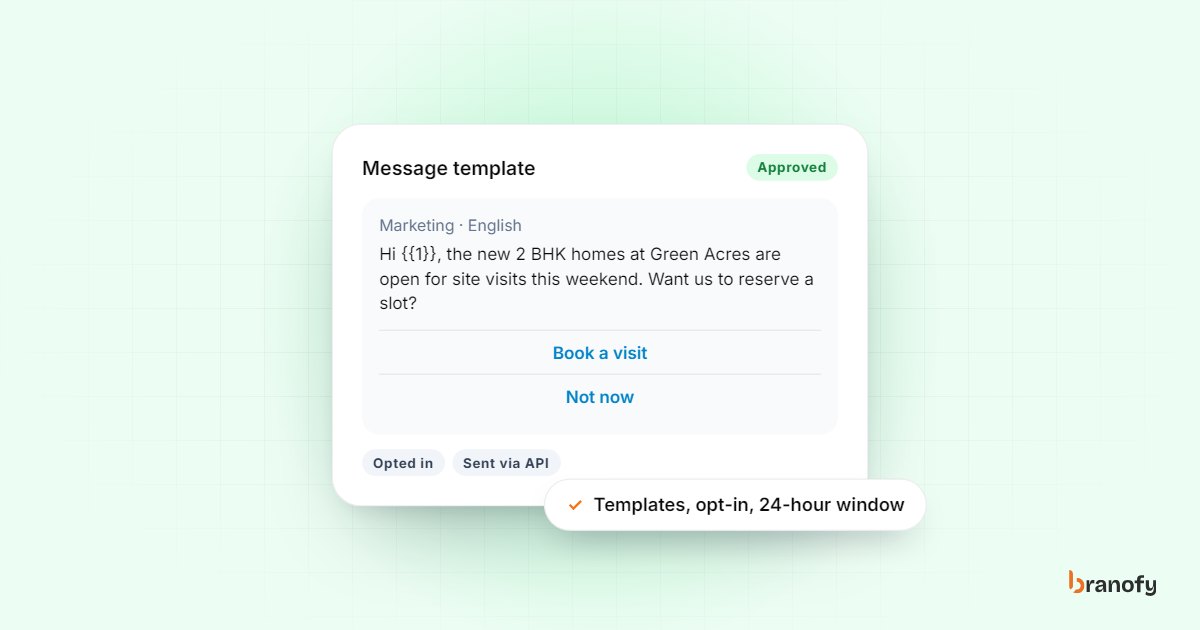
How to automate WhatsApp Business messages the right way
WhatsApp Business app vs API, template approval, the 24-hour window, opt-in and Meta's per-message pricing, plus what to automate first for an Indian SMB.
December 17, 2025
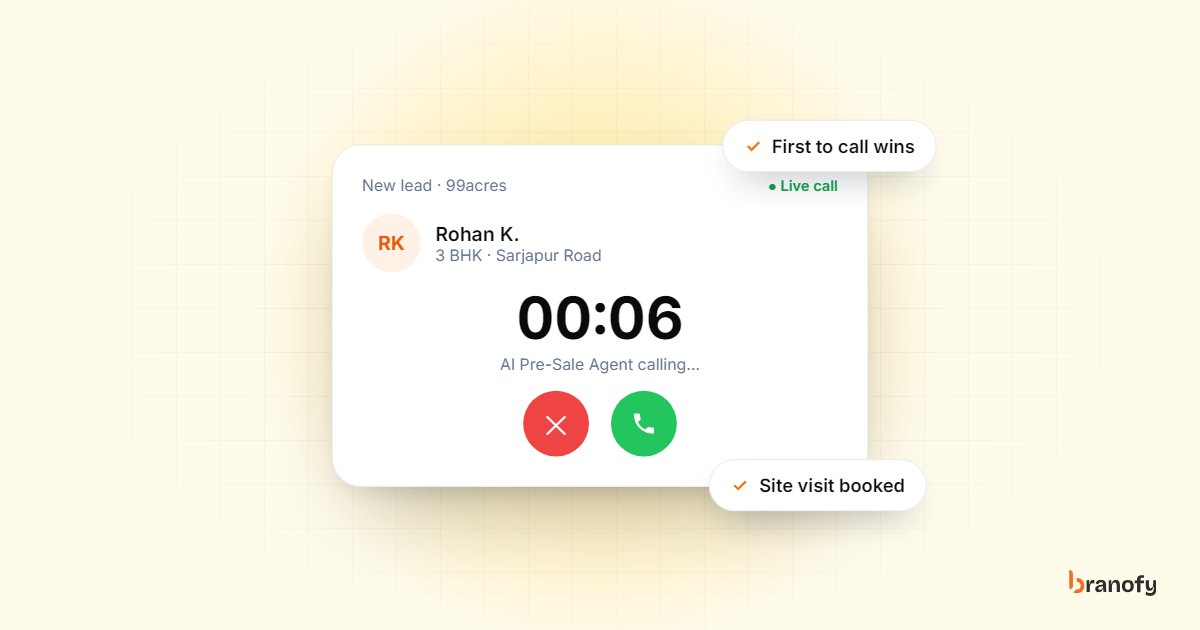
Speed-to-lead in Indian real estate: why the first call wins
Indian property buyers enquire with several projects at once, and the developer who calls first usually books the visit. How to get your response time down.
October 27, 2026
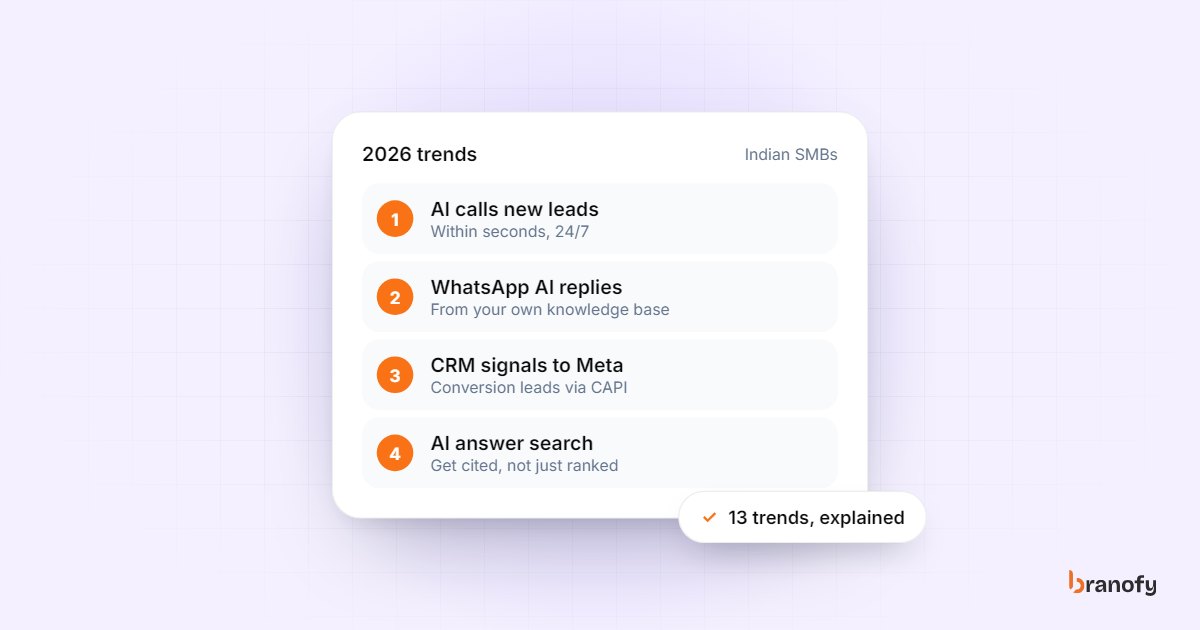
13 AI marketing automation trends for Indian SMBs in 2026
The AI marketing automation trends that matter for Indian SMBs buying leads from Meta, Google and portals in 2026, and which ones to act on first this year.
February 3, 2026