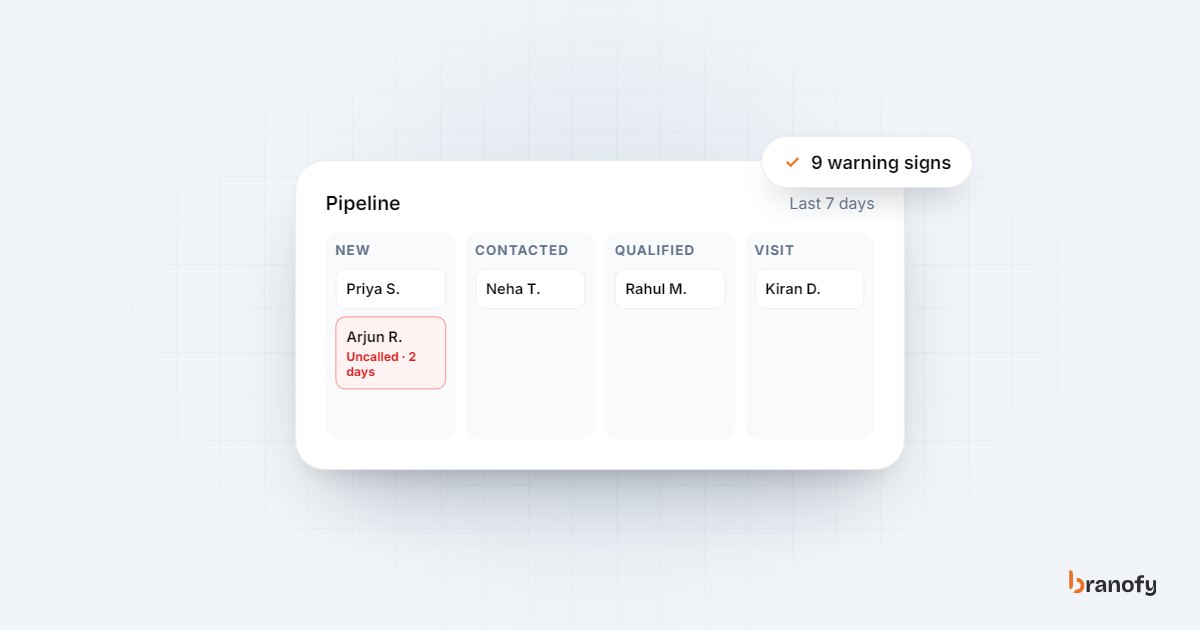
9 signs your CRM isn't working as hard as you are
On this page
Your CRM isn't working as hard as you are if new leads sit uncalled, nobody can say which campaign produced a sale, follow-ups depend on someone's memory, and your team still runs the real work on WhatsApp and spreadsheets. A CRM should call, remind, route and report for you. If you are doing those jobs by hand, the CRM has become a filing cabinet you pay for.
Below are nine signs we see most often in Indian businesses that buy leads from Meta, Google and portals, and what to change for each one.
1. New leads sit for hours before anyone calls
What it looks like: a lead arrives at 8:40 pm, gets assigned the next morning and is called after lunch. Nobody notices, because the CRM shows the lead as "assigned", not as "waiting".
This is the most expensive sign on the list. Research on lead response time, including the Harvard Business Review study of online sales leads, found that leads contacted within an hour were far more likely to qualify than leads contacted later. Buyers enquiring about a flat, a treatment or a course usually contact several businesses at once, and the first one to call has the advantage.
The fix: make the first call automatic. Either a rule that pushes every new lead to an available person within a minute, or an AI call that happens within seconds and hands qualified leads to the team. Then track the median time from form submission to first call, every week.
2. You can't tell which campaign a customer came from
What it looks like: someone books a flat or joins a course, and when you ask which ad brought them in, the answer is "Facebook, I think".
Without source tracking, you can only judge campaigns on cost per lead. You keep spending on campaigns that bring cheap enquiries and cut the ones that bring buyers.
The fix: connect lead sources directly instead of downloading or forwarding them. Each lead should arrive with its campaign, ad set, ad and form or portal listing attached, and that information should stay on the lead all the way to "won", so you can report cost per sale by campaign.
3. Follow-ups depend on someone remembering
What it looks like: the lead said "call me next week". The rep wrote it in a notebook, went on leave, and the lead was never called again.
Many leads are not ready on the first call. If the second, third and fourth touches depend on memory, they often do not happen.
The fix: every lead that is not won or lost should have a next action with a date. Set inactivity alerts so a lead that nobody has touched for one, three or seven days is flagged. Use automated WhatsApp and email sequences for the leads that are not ready yet, so they hear from you even when the team is busy.
4. Your team types more than it talks
What it looks like: reps copy leads from emails into the CRM, type call notes after every call, and update stages at the end of the day, if at all.
Manual entry is slow, and it is the first thing to be skipped when the team is busy. The CRM then holds incomplete data, which makes every report unreliable.
The fix: remove as much typing as possible. Leads should arrive automatically from every source. Calls should be recorded and summarised automatically, with the summary attached to the lead. Stage changes should be one tap. The test is simple: could a rep do a full day's work in the CRM without opening a spreadsheet?
5. WhatsApp lives outside the CRM
What it looks like: the real conversation with the buyer happens on a rep's personal WhatsApp. When that rep leaves, the conversation, and often the customer, leaves with them.
In India, many buyers would rather reply on WhatsApp than pick up a call from an unknown number. A CRM that ignores WhatsApp misses a large part of the conversation.
The fix: use the WhatsApp Business API connected to your CRM, so the team chats from a shared inbox and every message sits on the lead record. Use approved templates for brochures, location pins and reminders, and automate first replies for messages that arrive after hours.
6. Every lead gets the same treatment
What it looks like: a parent who wants admission this month, a student who is "just checking fees" and a wrong number all sit in the same list, in the order they arrived.
When everything is a priority, the best leads wait behind the worst ones.
The fix: qualify every lead on the first contact and sort the list by result. Agree on four or five questions, such as budget, timeline, location and decision-maker, and mark each lead as HOT, WARM or COLD with a reason. Your senior people call HOT leads first; WARM leads go into nurture; COLD leads go into a longer sequence or broadcast list. If brokers posing as buyers are a problem, add a polite question to filter them; our answer on filtering brokers covers how.
7. Evenings and Sundays are a black hole
What it looks like: leads that arrive after 7 pm or on Sunday wait until the next working day. Your ads keep running all weekend, but your response does not.
People research property, treatments and courses when they finally have time, which is often outside office hours. If your CRM only works when your team does, you are paying for weekend leads and answering them on Monday.
The fix: decide what happens to an after-hours lead. Either roster someone, or automate the first call and the first WhatsApp reply so the buyer hears from you immediately, then pass the qualified ones to the team in the morning.
8. Reports take a day to build, and nobody trusts them
What it looks like: the owner asks how last month's campaigns did, and someone spends a day exporting, cleaning and pivoting data in a spreadsheet. The numbers still do not match what the ad manager shows.
The fix: once sources and stages are captured automatically (signs 2 and 4), the core report should be a view, not a project. At minimum you want leads, contact rate, qualified leads, visits or appointments and sales, by source and by campaign, for any date range.
9. Your team doesn't use it
What it looks like: the CRM has logins for everyone, but the real work happens on phones, notebooks and WhatsApp groups. The CRM is updated before the weekly review meeting.
This is usually the result of the eight signs above, not a discipline problem. If the CRM makes the team's day harder, they will work around it.
The fix: make the CRM the fastest way to do the job. New leads should appear there first, with call recordings, summaries and WhatsApp chats in one place. Managers should run reviews from it, so updates matter. And it should be simple enough that a new telecaller can use it on day one.
What a CRM that works hard looks like
Put together, a CRM that does its share of the work:
- Receives leads from every source automatically, with the campaign attached.
- Calls or routes every new lead within seconds or minutes, day and night.
- Qualifies leads on the first contact and sorts them by intent.
- Keeps every WhatsApp conversation, call recording and summary on the lead.
- Reminds the team, and follows up automatically, when a lead goes quiet.
- Shows cost per qualified lead and cost per sale by campaign without a spreadsheet.
This is what Branofy built Lead Navigator to do. It combines a CRM that captures leads from Meta, Google Ads, 99acres, MagicBricks, website forms and Google Sheets with AI calling that reaches every new lead within 10 seconds, WhatsApp team chat, follow-up sequences with inactivity alerts and broadcasts. The Platform starts at ₹1,999 a month for five team seats; the pricing page has every plan and bundle.
How to check your own CRM this week
You can test most of these signs in an hour:
- Take 20 recent leads and note when each arrived and when it was first called.
- Pick five recent sales and check whether the CRM shows the campaign that produced them.
- Count how many open leads have no next action or have not been touched for seven days.
- Ask two reps where they keep their WhatsApp conversations with buyers.
- Time how long it takes to produce last month's leads-to-sales report by campaign.
Any answer you do not like points to the fix above. Start with sign 1, because faster first contact improves every number that follows. Our guide to speed-to-lead for Indian real estate goes deeper on that first step.
Frequently asked questions
How do I know if my CRM is the problem or my process is?
+
Check whether the CRM makes the right action the easy one. If leads arrive automatically, reminders fire on their own and reports are a click away, but the team still ignores them, the issue is process and management. If the team has to do everything by hand, the tool is part of the problem.
Do small businesses really need a CRM?
+
If you buy leads from ads or portals, yes. Even a team of three loses leads when enquiries live across email, WhatsApp and spreadsheets. The CRM does not need to be complex; it needs to capture every lead, prompt the next action and show where sales came from.
Should my CRM include WhatsApp?
+
For most Indian businesses, it should. Buyers often prefer to reply on WhatsApp, and conversations on personal phones are lost when staff change. A shared WhatsApp inbox connected to the CRM keeps every message on the lead record and lets you automate first replies and follow-ups.
What is the single most important CRM metric to track?
+
Median time from enquiry to first call. It is easy to measure, it is usually worse than teams believe, and improving it lifts contact rate, qualification rate and sales without spending more on ads.
How long does it take to switch to a better CRM?
+
It depends on how many lead sources and team members you have. With Branofy, go-live happens within 48 hours of receiving all your details, including lead source connections and qualifying questions. Plan an extra week or two for the team to settle into the new routine.
How Branofy does this for you
Branofy is the CRM that works your leads
- Lead Navigator pulls leads from Meta, Google Ads, 99acres, MagicBricks, Sheets and website forms into one CRM.
- AI calls, qualifies and follows up on every lead, so nothing sits untouched in a pipeline.
- Pipelines, lead scoring, AI summaries and team seats are included from ₹1,999 a month.
Want this working for your leads?
Leave your details and we'll call you back to show Branofy on your own lead flow.
Related Articles
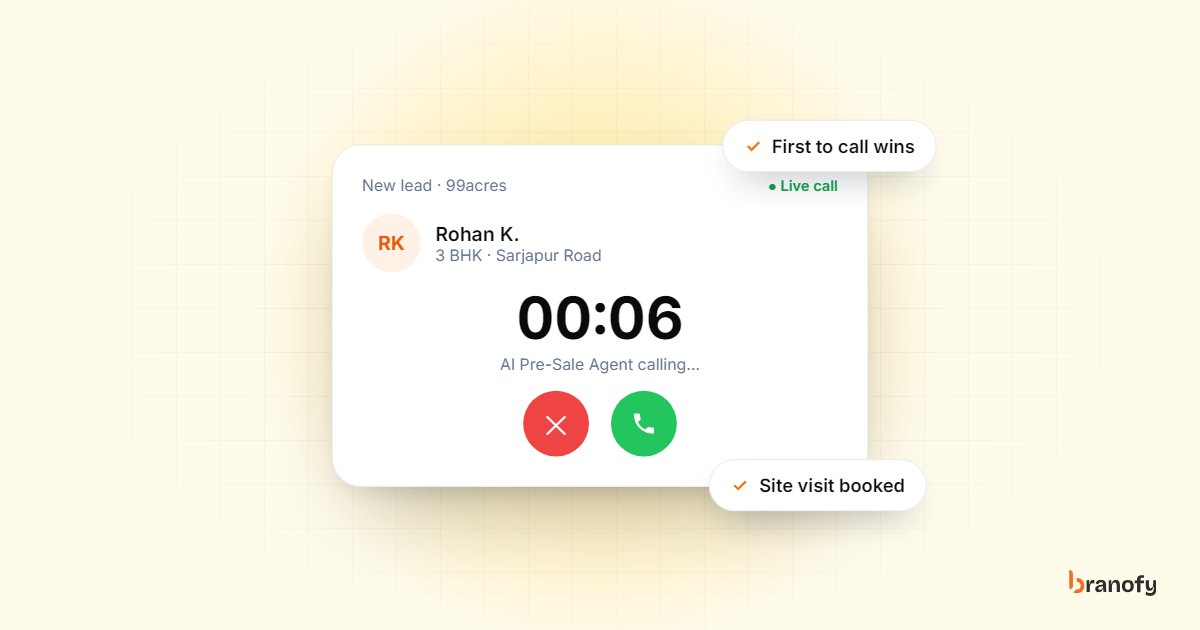
Speed-to-lead in Indian real estate: why the first call wins
Indian property buyers enquire with several projects at once, and the developer who calls first usually books the visit. How to get your response time down.
October 27, 2026
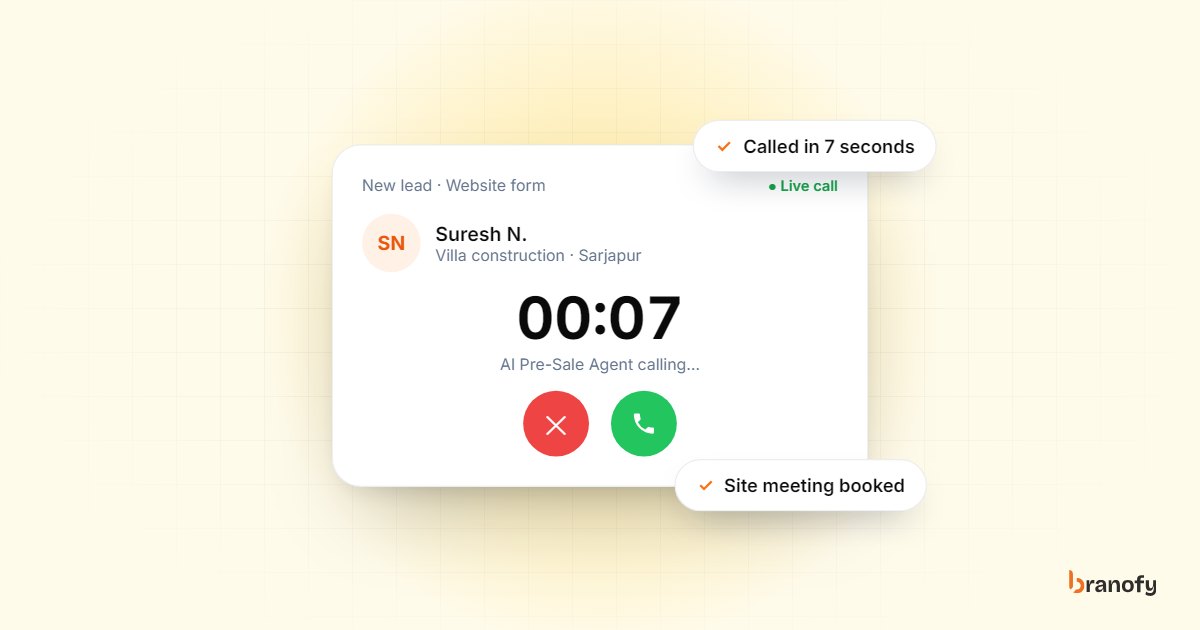
Automated lead generation for construction and interiors firms
How construction and interiors firms in India can automate lead capture, instant calling, qualification on plot, budget and timeline, and WhatsApp follow-up.
January 25, 2026
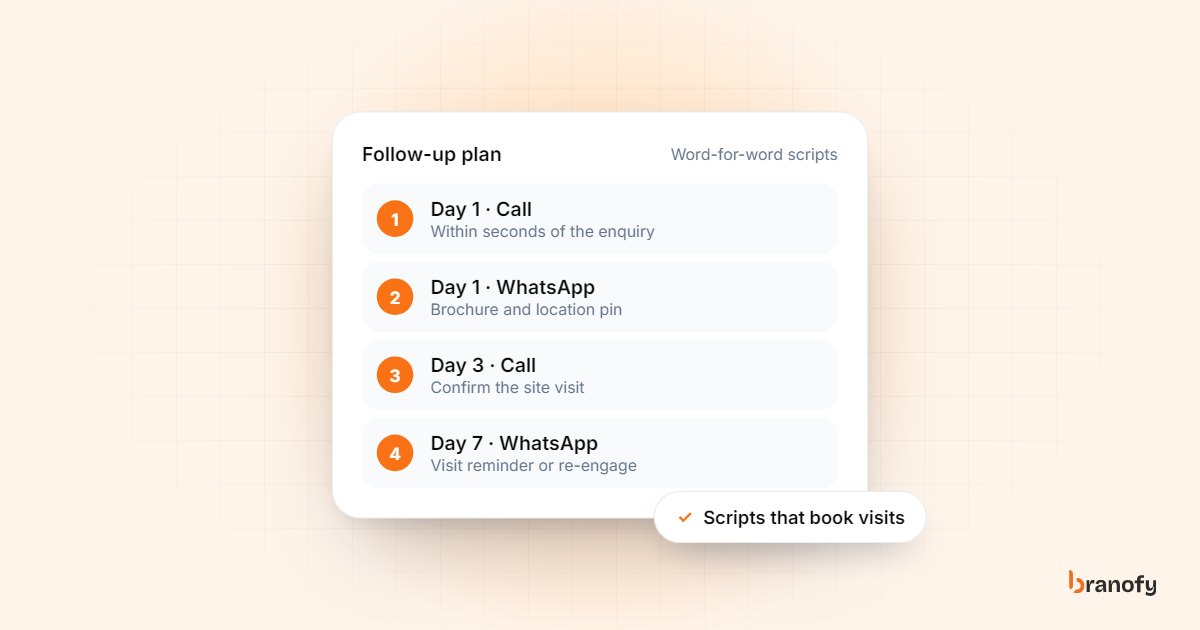
Real estate follow-up scripts that book more site visits
Word-for-word call and WhatsApp follow-up scripts for Indian real estate teams, from the first call to the site visit no-show and the lead that went quiet.
January 13, 2026